

Can a Golf Hitting Mat Make Your Practice Numbers Look Better Than They Really Are?
Turf height, surface firmness, impact response, and hitting-strip construction can all influence what happens between the club and the ball.
When golfers build an indoor practice area or Golf Simulator, most of the attention usually goes to the launch monitor, projector, impact screen, and software.
The Golf Hitting Mat can easily become an afterthought.
But the surface directly underneath the golf ball is part of every single shot.
Its turf height, density, firmness, base structure, and response to the club can influence how the club interacts with the surface — and in some situations, even how the resulting launch-monitor data should be interpreted.
A golf mat is not simply something to stand on.
The hitting surface is part of the contact environment, which means its construction can influence both feel and feedback.
Why Are Golfers Talking About Hitting Mats and Launch Monitor Data?
Indoor golf practice has become increasingly data-driven.
Golfers can now monitor carry distance, launch angle, spin, ball speed, club path, and many other measurements during a practice session.
That makes consistency in the hitting environment increasingly important.
If the ball sits differently on the mat than it does on natural turf, the club may contact the ball at a slightly different vertical position on the face.
For example, a particularly soft or fluffy turf surface may allow the ball to sit slightly higher above the underlying base.
That does not automatically make the mat good or bad. It simply means the golfer should understand that different hitting surfaces can create different contact conditions.
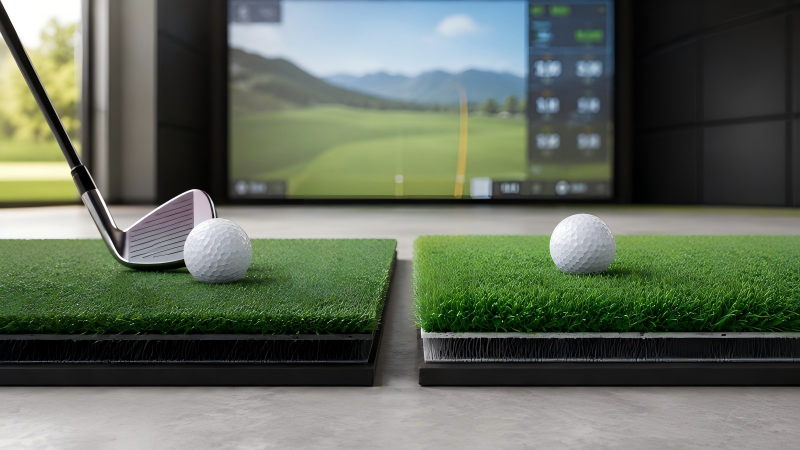
A Small Change in Ball Height Can Change Strike Location
Golfers often think about contact in terms of heel, center, and toe.
But vertical strike location is important too.
If a ball sits higher relative to the lowest point of the golf swing, impact can move farther up the clubface.
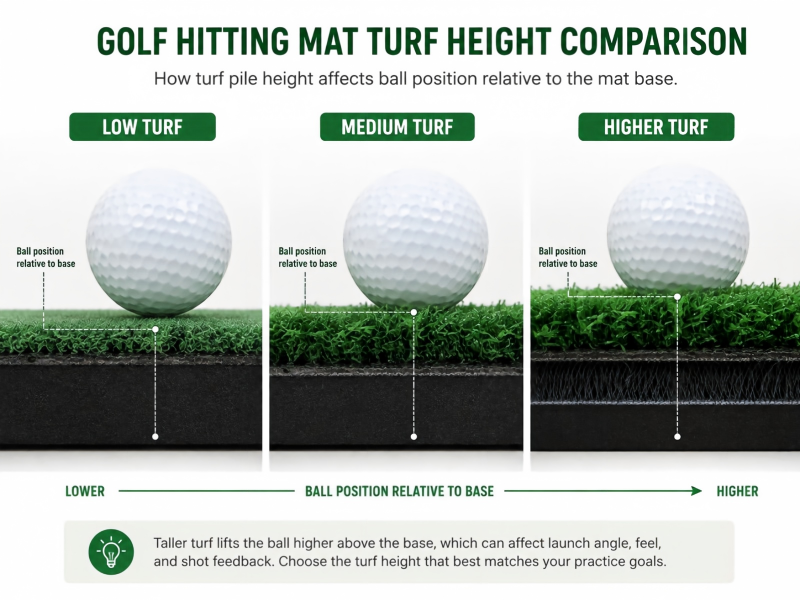
This becomes particularly relevant with irons, where golfers generally expect a certain relationship between the ball, clubface, and ground.
A higher strike can influence:
- Launch angle
- Spin rate
- Carry distance
- Impact feel
- Vertical strike pattern
That is one reason golfers should avoid judging a practice mat only by whether the ball seems easy to hit.
Why a “Great Shot” on a Mat May Need More Context
Imagine hitting an iron indoors and seeing an unusually high launch with lower spin and extra carry.
It is tempting to assume that the swing has suddenly improved.
Sometimes it has.
But the hitting surface is another variable worth checking.
If the ball is sitting higher in the turf, or if the club is interacting differently with the mat beneath the ball, the numbers may not represent exactly the same impact conditions found on a fairway.
Launch-monitor numbers should always be interpreted in context. The golf ball, club, hitting surface, environment, and quality of strike are all part of that context.
This Does Not Mean Golf Mats Are Bad for Practice
Artificial hitting surfaces remain extremely useful.
A quality Golf Practice Mat allows golfers to create a consistent practice area in places where natural turf may not be available.
That includes:
- Golf simulator rooms
- Indoor golf clubs
- Driving ranges
- Teaching studios
- Commercial training facilities
- Hotels and entertainment venues
- Home practice spaces
The key is understanding what type of feedback the mat is designed to provide and matching the construction to the application.
Turf Height Is Only One Part of Golf Mat Design
It would be too simple to judge every Golf Hitting Mat only by the height of its artificial grass.
The complete structure matters.
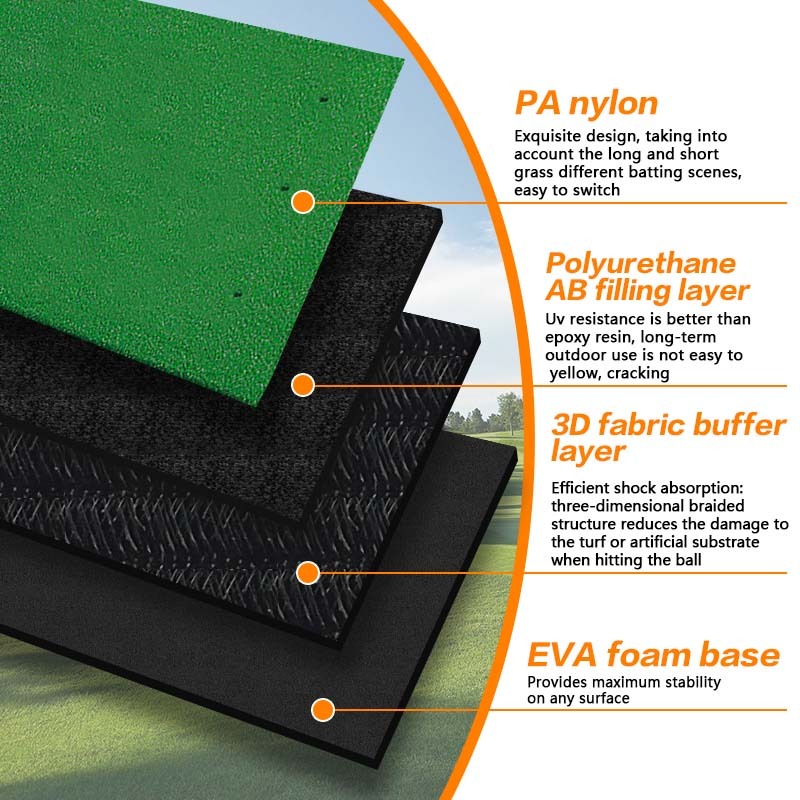
A mat may combine:
- Artificial nylon or synthetic turf
- Supporting turf layers
- EVA cushioning
- Foam or resilient layers
- 3D structural layers
- Rubber or non-slip backing
Each layer affects how the mat feels beneath the golfer and how the hitting area responds during impact.
Firmness Changes the Way the Club Interacts With the Surface
A very firm mat may provide a clear and stable hitting platform, but the club can experience a relatively abrupt response when it contacts the surface.
A softer construction may allow more movement beneath the club.
Neither approach automatically suits every golfer or every commercial application.
The appropriate balance depends on factors such as:
- How frequently the mat will be used
- Whether beginners or experienced golfers are using it
- Whether the facility prioritizes practice feedback or entertainment
- The type of clubs commonly used
- The underlying floor
- The overall simulator or driving-range design
For commercial installations, surface feel also needs to be considered together with durability, maintenance requirements, replacement cost, and expected daily traffic.
The Hitting Strip May Matter More Than the Standing Area
Not every part of a large golf mat needs to perform the same function.
The standing area primarily provides a stable platform for the golfer.
The Golf Hitting Strip, however, receives repeated club contact and directly influences the interaction between the golf club and the practice surface.
For this reason, many commercial mat systems use a separate hitting zone.
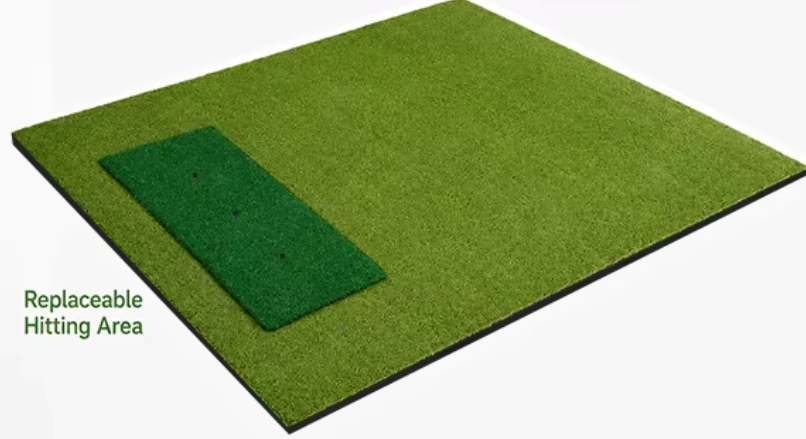
This type of modular construction can offer several practical advantages:
- The hitting zone can use a different structure from the standing area
- Frequently used sections can be replaced independently
- Different turf configurations can be tested
- The complete platform does not need to be replaced when one area wears
- Commercial customers can configure the practice area around their project
For facilities with multiple hitting bays, replaceable sections can also make ongoing maintenance more manageable because the highest-wear component can be treated separately from the larger platform.
Check Your Strike Pattern, Not Just the Screen
If a golfer is using a launch monitor, it can be useful to occasionally check where the ball is actually contacting the clubface.
A temporary impact marker can help reveal whether the strike is consistently:
- High on the face
- Low on the face
- Toward the heel
- Toward the toe
- Near the intended center area
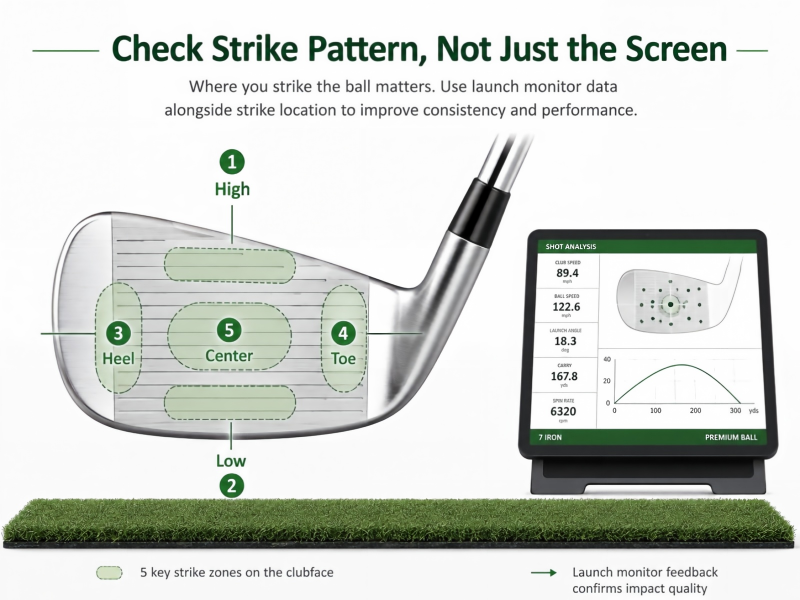
Looking at strike location alongside launch-monitor data provides more context than relying on carry distance alone.
If the numbers suddenly change after moving from one hitting mat to another, the surface is one variable worth investigating.
It can also be useful to compare several shots rather than drawing conclusions from one particularly good or bad strike.
Indoor Data and Outdoor Performance Are Not Always Identical
No artificial surface reproduces every possible condition found on a golf course.
Natural turf itself changes with:
- Grass type
- Moisture
- Soil firmness
- Cut height
- Lie quality
- Weather and season
For that reason, indoor practice is best viewed as a controlled training environment rather than an exact copy of every outdoor lie.
A Golf Hitting Mat provides repeatability, while natural grass provides variability.
Both can play useful roles in practice.
The goal is not necessarily to make an artificial mat behave like every possible fairway condition. A more realistic objective is to create a stable and understandable practice environment so golfers know what type of feedback they are receiving.
What Should Buyers Look for in a Golf Hitting Mat?
Buyers should also consider how the mat will be installed and maintained over time.
A product used for occasional home practice may face very different demands from a mat installed in a busy commercial golf venue where hundreds of shots can be played from the same hitting area every day.
For Commercial Buyers, One Mat Does Not Have to Fit Every Project
Golf mat requirements can vary considerably from one project to another.
A high-volume indoor golf venue may prioritize durability and replaceable hitting sections, while a premium simulator room may place greater emphasis on surface appearance, integrated flooring, and customized dimensions.
A golf academy may require several identical practice stations, while a distributor may want a different turf structure, color, logo, or packaging for its market.
That is why Golf Simulator Mat and commercial hitting-mat projects should be evaluated according to the intended application rather than selecting a product based on appearance alone.
Important questions for commercial buyers can include:
- What turf height and surface structure will be used?
- Is the hitting section replaceable?
- How is the mat constructed beneath the turf?
- What level of firmness or cushioning is appropriate?
- What dimensions are required for the simulator or hitting bay?
- How frequently will the product be used?
- Can the turf, dimensions, logo, or packaging be customized if required?
For distributors, golf facilities, simulator builders, and project contractors, discussing these details before production can help ensure that the mat configuration matches the intended environment.
The most suitable golf mat is not necessarily the softest, thickest, or easiest surface to hit from.
The better question is whether its turf structure, impact response, stability, durability, and hitting-zone design match the way the practice area will actually be used.
So, Can a Golf Hitting Mat Make the Numbers Look Better?
Potentially, a hitting surface can contribute to different contact conditions — and those conditions can influence the numbers a golfer sees.
That does not mean every favorable launch-monitor result from a mat is misleading.
It means the mat should be treated as one part of the complete practice environment.
If turf height changes the way the ball sits, if the club interacts differently with the surface, or if strike location changes between mats, launch, spin, carry, and feel may also change.
The most useful approach is to combine launch-monitor numbers with strike-location awareness and an understanding of the hitting surface itself.
For golfers, that creates better context for indoor practice.
For commercial buyers, it also highlights why the construction of a Golf Hitting Mat deserves just as much consideration as its size, appearance, and price.
Planning a Golf Simulator or Commercial Practice Area?
Consider the turf surface, hitting-zone construction, cushioning structure, dimensions, expected usage, and replacement strategy together. A well-matched mat configuration can create a more consistent and practical practice environment.